
|
Resources for GEMS March 2017 session
|
Failing to establish adequate alveolar oxygen delivery by any of the 3 supraglottic ventilation techniques (facemask, supraglottic airway and endotracheal tube).
If a 'best effort' at each of these three lifelines is unsuccessful then a can't intubate, can't oxygenate situation (CICO) situation exists and 'CICO Rescue' (emergency front-of-neck access) must be initiated. |
How is CICO poorly managed?
|

Difficult airway?
Any clinician managing an airway should assess the airway for potential difficulty.
Difficulty may refer to (1) patient anatomy, (2) patient physiology or the (3) situation.
In their editorial “The myth of the difficult airway: airway management revisited” Huitink & Bouwman state:
“In our opinion, the ‘difficult airway’ does not exist. It is a complex situational interplay of patient, practitioner, equipment, expertise and circumstances.”
Any clinician managing an airway should have a plan in place and be prepared to deal with difficulties as they arise.
The UK difficult airway society has very clear guidelines to aid our decision making:
Difficulty may refer to (1) patient anatomy, (2) patient physiology or the (3) situation.
In their editorial “The myth of the difficult airway: airway management revisited” Huitink & Bouwman state:
“In our opinion, the ‘difficult airway’ does not exist. It is a complex situational interplay of patient, practitioner, equipment, expertise and circumstances.”
Any clinician managing an airway should have a plan in place and be prepared to deal with difficulties as they arise.
The UK difficult airway society has very clear guidelines to aid our decision making:
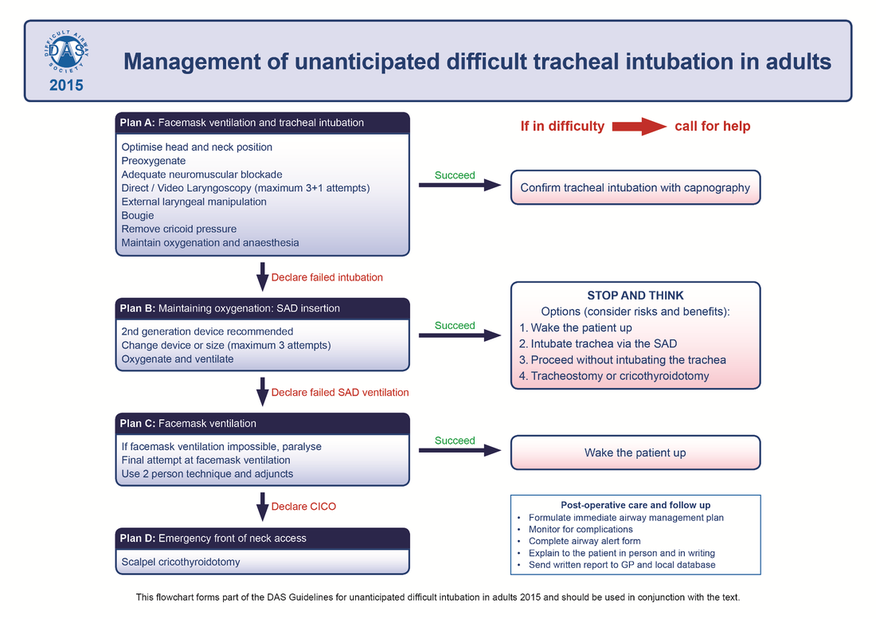
CICO Declared
The decision to perform a surgical airway is often delayed, for various reasons. We should all be familiar with the Elaine Bromiley case, where a CICO situation was neither recognised nor declared and she suffered hypoxic brain damage and tragically died after a routine operation.
Some people may feel they acknowledge failure (their airway techniques failed) by making the decision to perform a surgical airway. The CICO situation should rather be seen as a situation where a surgical airway is inevitable, rather than using the term "failed airway".
Some people may feel they acknowledge failure (their airway techniques failed) by making the decision to perform a surgical airway. The CICO situation should rather be seen as a situation where a surgical airway is inevitable, rather than using the term "failed airway".
The procedure
|
1. DECIDE
|
|
5. BOUGIE
- Tracheal dilators / hook / haemostat in while scalpel still in place; then remove scalpel
- Finger vs Direct bougie vs Tracheal dilator
- Adult 60cm long, caude tip, size 6. Tracheal clicks, hold up, not more than 15 cm
6. TUBE
- Pass over bougie
- black line above balloon in just below skin
7. CHECK
- signs of adequate oxygenation / ventilation (etCO2, oxygen sats improving etc.)
- tie tube
Bottom Line
- Emergency Surgical Airway is a RARE (but technically not difficult) procedure to perform
- Declare CICO as soon as recognised
- Be prepared to perform emergency FONA “By failing to prepare, you are preparing to fail” -Benjamin Franklin.
- Know your kit
- Practise - as an individual (develop and practise task specific skills) and as a team (SIM)
Resources
- NAP 4
- The vortex approach to airway management
- Difficult airway society UK guidelines
- Pondering EM: assessing the airway in ED
- EMCrit Podcast 131 – Cricothyrotomy – Cut to Air: Emergency Surgical Airway (the resource page for all things cric)
- Lessons from the Bromiley case
- Teamwork in Emergency airway management
- CICO Course (online) Australia
- http://broomedocs.com/2011/06/cant-intubate-cant-ventilate-the-low-down-on-code-brown/
- http://www.jems.com/articles/2016/05/can-t-oxygenate-can-t-ventilate-can-t-intubate.html
- http://pedemmorsels.com/cant-intubate-cant-ventilate/
- http://www.emdocs.net/cant-intubate-cant-ventilate/
- http://lifeinthefastlane.com/ccc/cant-intubate-cant-ventilate/
- http://lifeinthefastlane.com/ccc/surgical-cricothyroidotomy/
- http://dontforgetthebubbles.com/the-needle-or-the-damage-done/
- http://resus.me/tag/airway/
